Rally Obedience: A Beginner's Guide
Rally obedience is a course of numbered signs, each asking for an exercise such as a turn, a halt and sit, or a spiral. You can talk to your dog the whole way round. How it works, how to start and what's available in Belgium.
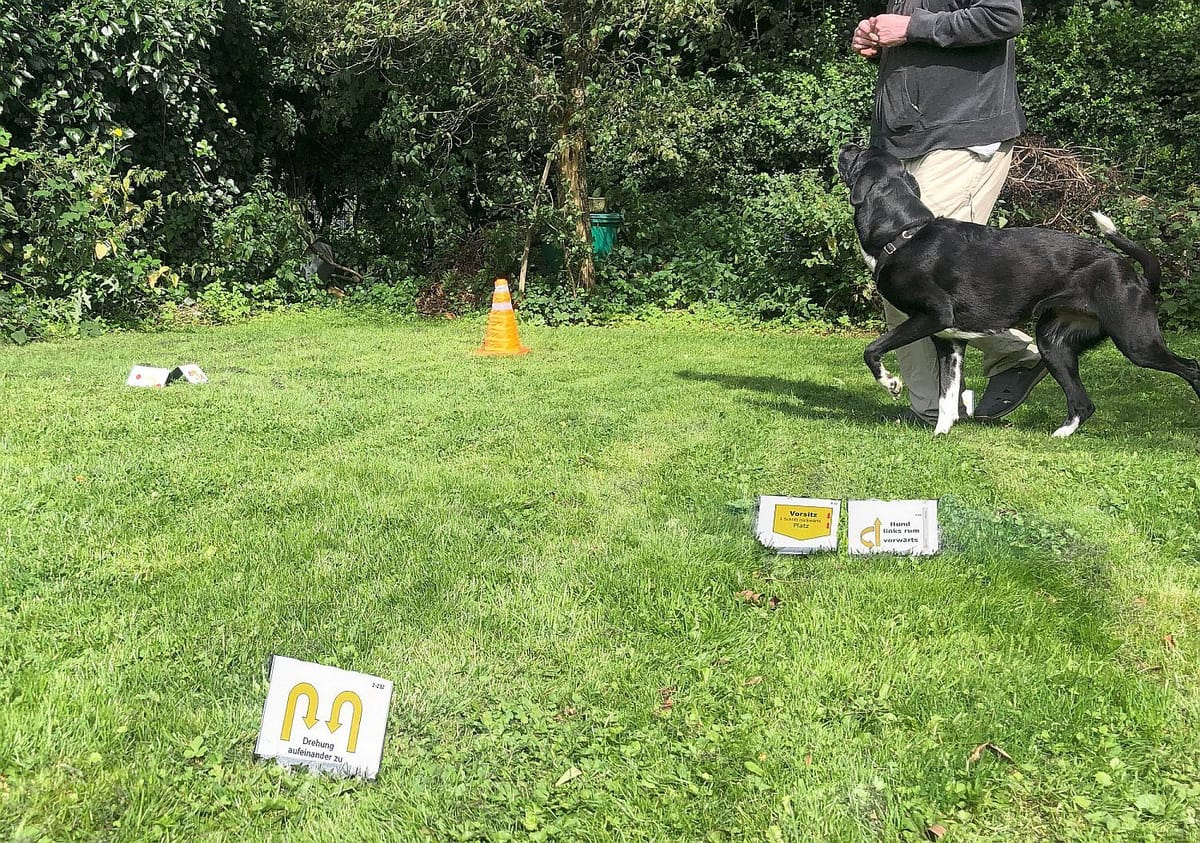
Rally obedience, often called rally or rally-O, is obedience with the stiffness taken out. You and your dog follow a course of numbered signs (up to 20 in the FCI international class). Each sign shows an exercise: a 270° turn, a halt and down, a serpentine through cones, or a call to front. Unlike traditional obedience, you may talk to your dog, praise it and give repeated cues as you go. That makes rally friendly for beginners, older dogs and handlers who find formal obedience nerve-racking.
What is rally obedience?
Rally was created in the USA around the turn of the millennium. Since then it has spread across Europe, often as a stepping stone between pet obedience classes and competitive obedience. The FCI now recognises it officially. Its Regulations and Rules for international FCI Rally Obedience trials were approved on 10 October 2023, came into force on 1 January 2024, and were amended in January 2025.
The FCI describes rally as a sport in which cooperation, pleasure and precision go together. The judge looks for a dog that works willingly and happily at your side, not just for straight sits.
How a rally course works
Before your class starts, there is a course walk without dogs. Under FCI rules this means a short briefing of up to 5 minutes from the judge, then 10 minutes to walk the course and ask questions. Then each team runs the course on its own:
- You enter the ring with your dog off lead (in the international class; national classes may allow a lead).
- You follow the signs in numbered order and perform each exercise, usually with the dog in heel position.
- Exercises include turns, circles and spirals, halts with position changes, pace changes and jumps. Each sign carries a point value from 1 to 4 that reflects its difficulty.
- No food, toys or treat pouches may be visible in the ring.
Scoring
In the FCI international class, every team starts with 100 points, and the judge deducts points for errors. Examples include a tight lead, a dog out of position, a repeated exercise, or the team on the wrong side of a sign. The final grades are:
- Excellent: 90–100
- Very good: 80–89.99
- Good: 70–79.99
- below 70 is a fail.
Some mistakes lead to disqualification, for example walking past a sign without attempting it, running the course in the wrong order, having treats or toys visible, or harsh handling.
Classes and age
The FCI defines the international class. Each national organisation decides its own national classes (beginners, intermediate and so on) and how teams move up. The FCI minimum age for the international class is 18 months, unless national rules set a higher age.
Who is rally for?
Rally suits almost everyone:
- Beginners who want a structured goal after puppy and basic obedience classes.
- Older dogs, and dogs that can't do high-impact sports, because rally is done at a walk or a jog. Jumps only appear in some exercises, so check your national rules if jumping is an issue for your dog.
- Handlers who like to chat to their dog and want a relaxed atmosphere.
- Obedience competitors who want to keep their dog's attitude bright.
Because you move at a walking pace, rally is also accessible to many handlers with limited mobility. The FCI rules include provisions for handlers with disabilities.
How to start training
You can start rally at home with a few cones and printed signs. Good first exercises:
1. Heel on both sides
Rally uses mostly left-side heelwork, but some exercises need the dog to move to your right. Reward your dog for staying close and looking up, first standing still, then walking a few steps.
2. Halt, sit; halt, down
Walk a few steps, stop, and ask for a sit at your side. Later, ask for a down from the sit while you stay upright. These are among the most common signs.
3. Turns
Practise right and left 90° turns, then 180° about-turns, then 270° and 360° circles. Use a treat at your dog's nose at first to guide it round, then fade the lure.
4. Pace changes
Mix slow, normal and fast walking, and reward your dog for adjusting smoothly.
5. Call to front and finish
Call your dog to sit in front of you, then send it back to heel position, either around behind you or with a swing to your left side.
Practise in short sequences of two or three signs. Then build a mini course of five to eight signs. The FCI and many national organisations publish their sign sets, so you can print them out and practise the real thing.
Equipment
- printed rally signs on cones or stands
- a few cones for serpentines and spirals
- a low jump (for the higher levels)
- a flat collar or harness and lead for training; check the national rules for what is allowed in the ring
- treats and toys for training, left outside the ring at competitions.
Rally obedience in Belgium
We found rally activity at Belgian clubs, but no published national rally competition calendar we could verify. Here is what we could confirm:
- Some Belgian dog schools teach rally. For example, the KKUSH-affiliated HS Pallieter in Berlaar lists Rally-O among its disciplines, including a recreational group. Ask your local dog school: many include rally in their obedience programme.
- Belgium's FCI member, the KKUSH, organises international-style obedience through VdA section 4D Obedience. Since the FCI made rally obedience an official discipline in 2024, this section is the logical first contact for questions about official rally trials under FCI rules in Belgium. Check its documents and calendar pages for current information.
- The Belgian federations VOE and DSAB do not list rally among their disciplines on their websites. VOE focuses on agility, obedience (GH), dog dance, Mondial Dogsport and hoopers. DSAB focuses on agility.
- The Netherlands has a large, well-established rally scene, and some Belgian handlers train or compete across the border. Check the organiser's rules on foreign entries and which national organisation you need to belong to.
If you want to compete, it is worth asking your club which rulebook it trains to, because sign sets and class structures differ between organisations.
Where rally can lead
Rally builds exactly the skills that help in competitive obedience: precise heelwork, positions and focus. The same focus and body awareness are useful in agility, where many handlers use rally-style exercises to sharpen start-line stays and turns. For more options, see our dog sports overview.