Agility in Belgium: The Complete Guide
Who runs agility in Belgium? A clear guide to VOE, DSAB, KKUSH and NVBK: how each organisation works, which international events they lead to, and how to choose the right path for you and your dog.
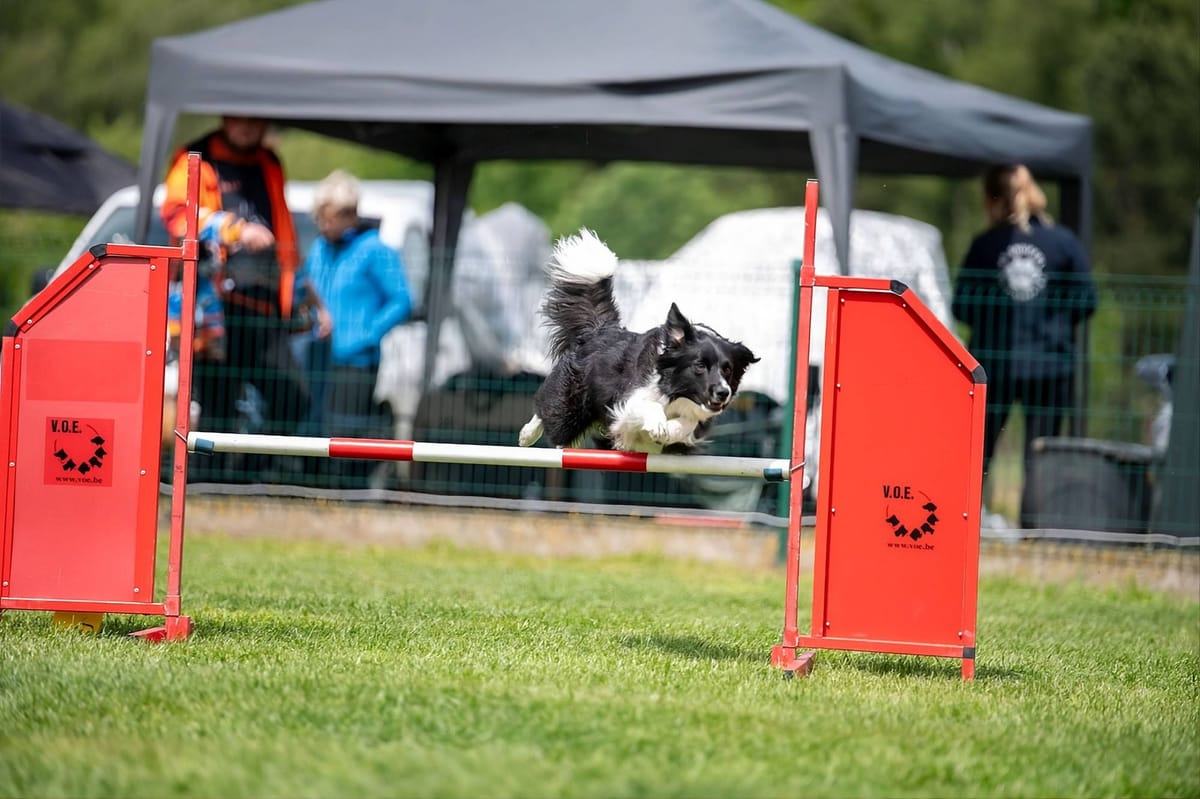
Belgium is a small country with a surprisingly busy agility scene. On almost any weekend of the year there is a competition somewhere in Flanders or Wallonia, and Belgian handlers regularly bring home medals from world and European championships. What can confuse newcomers is that there is no single "Belgian agility federation". Several organisations run their own competitions, with their own rules, paperwork and championships.
This guide explains who does what, how the organisations differ, and how to choose. For the step-by-step paperwork, see How to Start Competing in Agility in Belgium. Upcoming competitions are on our competition calendar, and with our course designer you can draw a practice course yourself.
The organisations at a glance
| Organisation | What it is | Pedigree needed? | Leads to |
|---|---|---|---|
| VOE (Hondenfederatie V.O.E. vzw) | Federation of dog clubs, mainly in Flanders, with some in Hainaut and Dutch Zeeland | No | VOE Belgian Championship, Superprestige, IFCS World Agility Championships (WAC), IMCA |
| DSAB (DogSport Agility Belgium) | Independent agility organisation | Not stated publicly, so check with DSAB | DSAB competitions, Belgian team for the World Agility Open (WAO) |
| KKUSH / URCSH, Section 4C | Belgium's FCI-affiliated national kennel organisation | No for national competitions; yes for FCI international events | FCI Agility World Championship (AWC), European Open (EO), JAO, SAO |
| NVBK / FNCB | Federation of dog clubs that has recently set up an agility commission | Not stated publicly | A small number of open competitions |
VOE: Hondenfederatie Vrienden Onder Eén
The Hondenfederatie V.O.E. vzw is a federation of dog clubs based in Ingelmunster (West Flanders). It is affiliated to the Kynologische Maatschappij V.O.E. vzw, founded in 1967, and is a member of the International Federation of Cynological Sports (IFCS) and the Union Cynologique International (UCI). It is also recognised by Sport Vlaanderen. Its clubs offer obedience, agility, dog dancing, Mondial Dogsport and hoopers.
What makes VOE attractive to many owners is its open approach. According to the federation, no ranking distinguishes between pedigree dogs, dogs without papers and mixed breeds. Every federal competition also has classes for young handlers and recreational entrants.
How VOE agility works in practice:
- Classes. The VOE sport calendar lists agility competitions with recreational, Grade 0, Grade 1, Open class and veteran classes.
- Recreational class. Newcomers can enter without a competition certificate, as long as their dog has never run in an official VOE agility competition and its vaccinations are up to date. The dog must be at least 18 months old. Recreational entrants run a jumping course and a standard course without weave poles (VOE youth and recreational page).
- Work certificate. To compete in the official classes you need a VOE werkcertificaat (work certificate booklet). The fee is lower for dogs with a VOE pedigree, but dogs with another pedigree or no pedigree are welcome too.
- Championships. Each season ends with a VOE Belgian Championship and a Superprestige ranking. Handlers qualify by running at least a third of the federal competitions.
- International. Through the IFCS, VOE sends a Belgian team to the World Agility Championships (WAC). The IFCS lists the "Cynological Society V.O.E." as its Belgian member. VOE also holds selections for the IMCA (International Mixbreed Championship in Agility).
DSAB: DogSport Agility Belgium
DogSport Agility Belgium (DSAB) is an independent organisation that runs agility competitions in Belgium. It also organises the Belgian try-outs for the World Agility Open (WAO). In Sport Vlaanderen's database it is registered as a sports club founded in January 2022, based in Lebbeke and affiliated to the Sporta federation.
DSAB's competitions follow the WAO style of agility:
- Courses and games. As well as standard agility and jumping, there are "games" such as snooker and gamblers, plus speedstakes and team relay. In gamblers and snooker you score points by choosing your own route, which makes them a fun change from numbered courses.
- Jump heights. DSAB uses the WAO's five height divisions (250, 300, 400, 500 and 600 mm) rather than the FCI's four categories. AgilityInfo shows the WAO height table on its DSAB page, and the full table is on the WAO heights page.
- WAO selection. To enter the try-outs for WAO 2027, a dog must have run at least two DSAB competitions (not counting try-outs) in the previous 12 months, entering every discipline on those days (Belgium WAO selection rules 2027).
DSAB posts its calendar and news mainly in its Facebook group. Join it if you are interested. DSAB's entry rules and its policy on pedigree dogs are not published on an open website, so ask the organisers directly before you enter.
KKUSH Section 4C: the FCI route
The Koninklijke Kynologische Unie Sint-Hubertus (KKUSH), or Union Royale Cynologique Saint-Hubert (URCSH) in French, is Belgium's member of the Fédération Cynologique Internationale (FCI). Agility is run by its Section 4C. This is the only route to FCI championships such as the Agility World Championship and the European Open. Belgium hosted the FCI Agility World Championship at Sentower Park in Opglabbeek in October 2024 (Royal Kennel Club report).
KKUSH competitions are open to dogs with or without a pedigree. However, the path in is more formal: a social behaviour test, a workbook, and an admission test called the TAP. Our competing guide covers each step. The rules come from the FCI agility regulations with Belgian additions; see FCI Agility Rules Explained for the international part.
NVBK: a newcomer to agility
The NVBK (Nationaal Verbond der Belgische Kynologen) is best known for ring sport, but it has recently set up an agility commission. It runs a small number of competitions that are open to handlers from any federation. The commission says it plans its dates around the VOE agility calendar, because many people compete in both. With so few competitions, it does not yet hold championships or a Superprestige.
Can you compete in more than one organisation?
Yes, and many Belgian handlers do. Some practical points:
- VOE lets members of other federations enter its competitions with a one-off IB number. These entrants can run as many competitions as they like, but they cannot qualify for the VOE Superprestige or Belgian Championship (VOE agility page). VOE's calendar also marks some events as "federal, open to all federations".
- NVBK welcomes everyone. It assumes that people from other federations are insured through their own federation.
- KKUSH requires every handler to belong to a KKUSH-recognised club. If your dog passed a social test under another federation and you switch to a KKUSH club, it must take the test again under KKUSH.
- Heights differ. FCI events use four categories (Small under 35 cm, Medium 35 to under 43 cm, Intermediate 43 to under 48 cm, Large 48 cm and over at the withers). The WAO uses five jump heights. Your dog may jump a different height depending on where it runs.
Which path suits you?
- You want relaxed, friendly competition with any dog: start with the VOE recreational class. You don't need a work certificate, and it's a gentle first taste of a competition day.
- You love variety and games: DSAB's WAO-style competitions with snooker and gamblers will suit you.
- You have an international team in mind: VOE leads to the IFCS WAC, DSAB to the WAO and KKUSH to the FCI AWC and EO. Each has its own selection system, explained in Belgium on the International Agility Stage.
- You aren't sure yet: join a club first. Your club's federation decides your easiest first step, and good clubs will happily explain the options. See Finding an Agility Club in Belgium.
Insurance
All three main organisations offer insurance, but through different systems:
- VOE members are covered through Dierenhobby's vzw (formerly VCHHD). The cover includes civil liability and personal accident insurance, for agility in competition, recreational sessions and training. The special conditions on the VOE insurance page were updated with effect from 1 July 2026.
- KKUSH has run a licence system since 1 July 2021. Members of affiliated clubs get civil liability, personal accident (including cover for the dog during club activities) and legal assistance insurance (VdA-AdD licences overview).
- NVBK has group insurance with Arena that is compulsory for members of affiliated clubs (NVBK).
- DSAB: check its insurance arrangements with the organisation directly.
Language and practicalities
Belgian agility is bilingual. Section 4C publishes everything in Dutch and French. VOE's website is mostly in Dutch, with some French, and its clubs are mainly in Flanders, plus a few in Hainaut. Briefings at competitions are usually in the local language, but agility vocabulary is very international, and fellow competitors will usually help an English speaker. Our agility glossary can help you follow course briefings.
Useful links
- Hondenfederatie V.O.E. vzw: clubs, calendar, insurance
- VOE online entries (voe-beheer.be)
- DogSport Agility Belgium on AgilityInfo and the DSAB Facebook group
- World Agility Open
- IFCS
- Section 4C (KKUSH agility)
- NVBK agility
- AgilityInfo.be: an independent Belgian overview site