Sheepdog Herding: How Sheepdog Trials Work and Where to Start in Belgium
A dog runs out hundreds of metres, lifts a small group of sheep and brings them calmly through gates and into a pen, guided only by whistles. Here's how sheepdog trials work, which dogs can do it and where to start herding in Belgium.
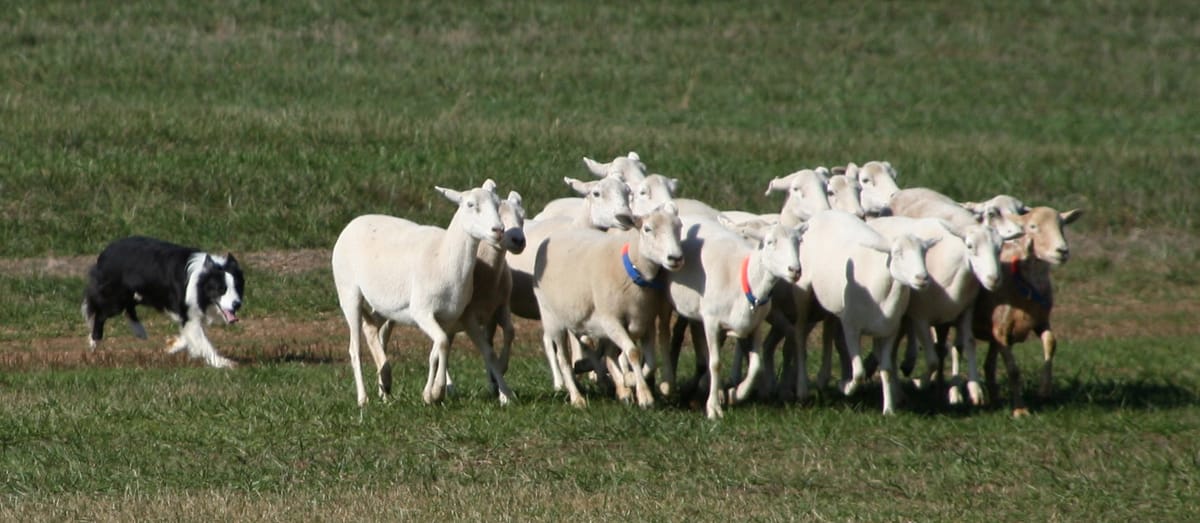
Few dog sports look as calm, and are as demanding, as sheepdog herding. A dog runs out a few hundred metres in a wide arc, settles behind a small group of sheep and brings them quietly to the handler, who stands at a post and steers the work with a few words and whistles. Then the dog drives the sheep through gates, splits the group and finally puts them in a small pen. It looks effortless when it goes well. It almost never does.
Herding grew out of real farm work, and in trials the dog's working ability is still what counts. This guide explains how a trial works, which dogs can take part, and how to start herding in Belgium, where the sport has a small but very active community.
How a sheepdog trial works
The classic format comes from the British trials of the International Sheep Dog Society (ISDS), which has been refining its rules for more than a hundred years. A run consists of a fixed sequence of tasks with a small group of sheep, usually around five (Wikipedia: Sheepdog trial):
- Outrun: the dog leaves the handler and runs out in a wide pear-shaped curve to get behind the sheep without disturbing them.
- Lift: the first contact. The dog moves the sheep off gently, in a straight line towards the handler.
- Fetch: the dog brings the sheep in a straight line through a gate to the handler.
- Drive: now the dog pushes the sheep away from the handler, around a triangular course through two more gates.
- Shed: dog and handler split off one or more sheep from the group.
- Pen: the sheep go into a small pen with a gate that the handler holds. Once the gate is shut, the pen is done.
- Single: in class 3 a single often follows: dog and handler separate one sheep from the group. Only then is the run over.
Each run starts with full marks and the judges deduct points for every deviation: sheep that zigzag, miss a gate or are rushed. A common scoring sheet gives 20 points for the outrun, 10 for the lift, 20 for the fetch, 30 for the drive, and 10 each for the shed and the pen (course description, Meeker Classic); a single is worth another 10 points. The time limit is between 8 and 15 minutes depending on the class, and up to 30 minutes at major championships where the dog runs a double outrun to collect two groups of sheep, as in the finals of the Continental and World championships. If time runs out, the remaining elements score nothing (USBCHA). The point is not speed but control: the sheep should move calmly and with as little stress as possible.
Commands and whistles
Handlers use a small set of commands, and the same words are used worldwide (The Border Collie):
- Come bye: go clockwise around the sheep.
- Away (to me): go anticlockwise.
- Walk on: move towards the sheep.
- Lie down: stop (lie or stand still).
- That'll do: stop working and come back to the handler.
At a distance of 300 metres, a voice doesn't carry, so experienced handlers switch to a shepherd's whistle. Each command gets its own whistle, and every handler develops their own set.
Classes in Belgium
Belgian trials use the same English course. The Belgian Border Collie Club explains that there are three classes, which mainly differ in distance:
- Class 1: an outrun of about 100 metres. The handler may still leave the post and walk along.
- Class 2: about 200 metres, and the handler stays at the post.
- Class 3: 300 metres or more, the top level.
The Belgian Sheep Dog Society organises the Belgian Championship in class 3 and selects the Belgian team for the big international trials. Belgium also has championships in class 1 and class 2. In September 2022, 21 handlers competed for that title at the open-air museum of Bokrijk, almost all of them with border collies (VRT NWS).
The FCI herding tests
Besides the traditional trials, the FCI has its own herding route for pedigree herding dogs:
- The Natural Herding Aptitude Test (NHAT) checks whether a dog has herding instinct. No training is needed, and dogs can take it from six months of age (NHAT regulations, via ČMKU).
- The Herding Working Test (HWT) comes in two styles: Collecting Style for border collies, and Traditional Style for other herding breeds that work in their own way (FCI HWT regulations).
Which dogs can herd?
The border collie dominates trials, and for good reason. The breed was developed from working dogs in the border country between Scotland and England, and today's border collies trace back to one dog, Old Hemp, born in the late 19th century (Wikipedia: Border Collie). Border collies control sheep with their famous eye: a fixed, intense stare that keeps the flock under control (Border Collie Museum).
Other herding breeds work in different ways. The Australian kelpie is known for running over the backs of tightly packed sheep. Breeds such as the Australian shepherd, the Belgian shepherd, the German shepherd and the Dutch schapendoes also belong to the FCI's herding group (FCI). Whether your dog can join a club depends on the club: some only train border collies, others accept any herding dog that shows clear ability and stays under control.
How to start herding in Belgium
You don't need your own sheep. Clubs keep their own flock, and the first step is almost always an instinct test: a short session with a trainer and a few calm sheep to see whether your dog shows interest and can be steered. Most clubs start dogs from about six to eight months, once vaccinations are up to date.
A few examples of clubs (always check their websites for current lessons and waiting lists):
- Hondenschool De Snuffel in Snaaskerke (Gistel, West Flanders): weekly herding on Sunday mornings and/or Tuesday evenings, taught by Alain Cools, for border collies and other herding breeds. You can come to a lesson first, where a few simple tests show whether your dog is suited.
- Belgian Border Collie Club in Vlimmeren (Antwerp): training in a summer and a winter season, with a compulsory instinct test (about €10–20). Only border collies.
- Schapendrijvers Denderstreek in Essene (Affligem): introductory lessons on Sunday mornings (three lessons for €45) before you can become a member (€125 a year). Other herding breeds are welcome if they show clear aptitude. They also organise trials and clinics.
- De Gezellige Blaffers in Zwevezele (West Flanders): herding on Sunday mornings for border collies and other dogs with herding instinct. At the time of writing the lessons were full and the waiting list was closed, but visitors are welcome to come and watch.
International trials
The big event in Belgium this year was the Continental Sheepdog Championship, held from 27 to 30 August 2026 at the Kristalpark festival field in Lommel, hosted by the Belgian Sheep Dog Society. Handlers from 19 countries took part, and it was the first time in 13 years that the championship came back to Belgium. A tornado on the Friday briefly forced the organisers to clear the site (VRT NWS).
The World Sheepdog Trials of the ISDS took place from 16 to 20 September 2026 at Huntington Farm near Lauder in the Scottish Borders, with competitors from more than 30 countries (ISDS).
Is herding for you?
Herding asks for patience. A young dog has a lot to learn, and as a handler you learn to read sheep just as much as your dog. In return you get a sport in which your dog does exactly what it was bred for, in the open air and with a bond that grows with every run. Curious? Go and watch a trial or a training session first; most clubs are happy to explain.
Want to compare with other sports? Read our overview of dog sports, see which breeds suit agility, or learn about ring sports in Belgium.