Hoopers: Agility's Low-Impact Cousin
Hoopers is a flowing, jump-free course sport where the dog runs through hoops, round barrels and through tunnels while the handler directs from a small box. Rules, first exercises and where to try it in Belgium.
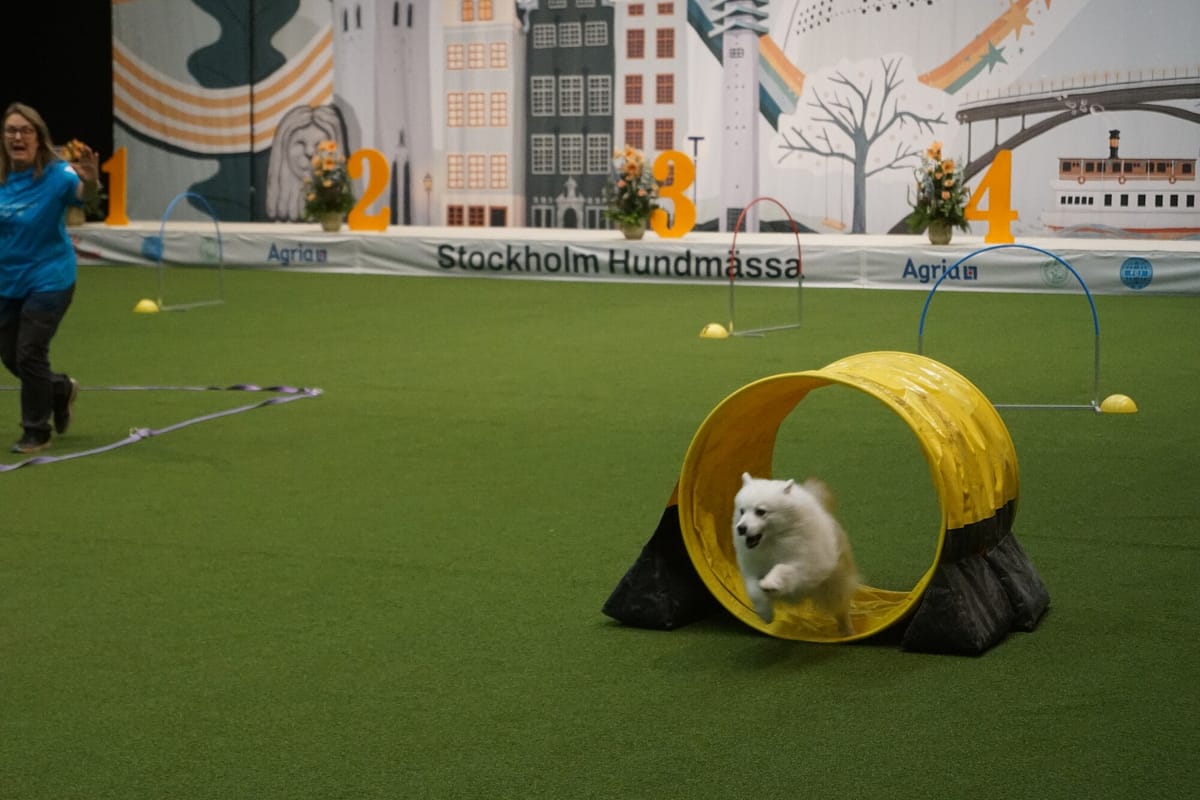
Hoopers looks like agility with the hard parts taken out. There are no jumps, no seesaw, no A-frame and no weaves. The dog flows around a course of arches ("hoops"), barrels, tunnels and gates, while the handler stays in a small handling area and steers from a distance. Because the impact is low, hoopers suits puppies in training, veterans, dogs that can't jump, and handlers who can't (or would rather not) sprint.
It is also a serious sport in its own right. In March 2026 the FCI approved its own international hoopers regulations. This article explains the sport, how to start, and where to find it in Belgium.
What is hoopers?
Hoopers comes from the United States, where it grew out of NADAC agility. In Europe it spread quickly through the Netherlands and Scandinavia, and it is now arriving in Belgium.
The core idea is distance handling. The FCI Hoopers Regulations describe it like this: the dog is guided from the handling area, "so the dog has to work independently". They also state that "the most important thing in course performance is not the time, but a clear and fluid run."
The obstacles
The FCI rules list five obstacle types:
- Hoop: an arch about 90–120 cm high that the dog runs through. The first and last obstacles must be hoops, and at least half of the course must be hoops.
- Barrel: the dog runs around it in the direction the judge sets.
- Gate: a low fence panel the dog runs past or around, often used to send the dog away from the handler.
- Chute: a short, soft-ended tunnel.
- Tunnel: an open tunnel, as in agility.
A course uses up to four of these types. Course designs avoid tight, punishing turns.
The handling area
The handler stays in a 2 × 2 m square or a 2 m circle (the handling area, or HA). Stepping out before the dog has taken the first obstacle is a fault. A handler may step out to correct the dog, but must then go back in.
How a competition works
Under the FCI rules:
- Size categories: two, Small (40 cm or less at the withers) and Large (over 40 cm). Dogs are measured officially, no earlier than 15 months of age.
- Classes: Hoopers 1, 2 and 3. Dogs move up by qualifying in the class below. National organisations may also add a beginners' class, H0.
- Course size: grows with the class. H1 courses have 12–18 obstacles, and the furthest obstacle is at most 12 m (Small) or 15 m (Large) from the handling area. H3 courses have 20–26 obstacles, at distances of up to 25 m (Small) or 30 m (Large).
- Faults: 5 points each, for example for a refusal, a missed obstacle, the dog leaving the running line, or the handler calling the dog into the HA.
- Disqualification: for example for harsh handling, a dog running with a collar or harness, or a dog fouling the ring.
- Rewards: collars, leads, toys and treat pouches must be out of sight before the handler steps into the handling area.
For national trials, the FCI rules allow dogs over 18 months, with or without a pedigree. International FCI trials require dogs over 24 months with an FCI-recognised pedigree. Each national organisation may write its own national rules, so check locally.
Which dogs suit hoopers?
Almost any healthy dog can do hoopers. The VdA section 3A describes it as suitable for all breeds and sizes, including young, older and less robust dogs. Because the handler stays in the handling area, it suits young and older handlers too. The Belgian federation VOE describes it in the same way: a sport for dogs that are too young, too old or not physically able for more intensive sports such as agility or flyball.
Hoopers is a particularly good fit if:
- you want to start a young dog on course work before it is ready for jumps
- you want to keep a retired agility dog busy
- you have limited mobility, or simply prefer not to run
- you want to improve your distance handling for agility.
How to start training
The VOE notes that hoopers should be taught pressure-free, one obstacle at a time, with an early focus on the dog working independently. Here are a few first exercises.
1. Hoop value
Put a single hoop in the garden. Reward your dog every time it passes through, with a treat thrown ahead or a toy. Then start rewarding from slightly further away, so the dog learns that going through the hoop pays, wherever you stand.
2. Barrel wraps
Teach your dog to circle a barrel (or a bucket at first) in both directions on a verbal cue, such as "left" and "right". Lure it at first, then fade the lure and add distance.
3. Send to a tunnel
With a short, straight tunnel, reward your dog at the exit. Gradually stand further back and to the side, so your dog learns to drive into the tunnel without you running alongside.
4. Line of hoops
Set three to five hoops in a gentle line. Stand at one end and send your dog down the line, throwing the reward ahead to keep it moving away from you.
5. Stay in your box
Mark a 2 × 2 m square on the ground and practise all of the above without leaving it. This is harder than it sounds, and it is the heart of the sport.
Equipment
To get started you need very little. A few hoops (bought, or home-made from plastic pipe with no crossbar between the legs), a barrel or large bucket, and a short tunnel go a long way. The FCI rules ask for lightweight, shatterproof hoops without sharp edges or crossbars, with a lower part that is clearly visible to the dog. Use flat, non-slip ground, and avoid tight, twisting lines for young dogs.
Hoopers in Belgium
Hoopers is still young in Belgium, but it now has a formal place in the national structure.
- KKUSH / VdA section 3A Hoopers. The VdA (Vergadering der Afgevaardigden), which groups the clubs affiliated to the FCI-recognised KKUSH, has a dedicated section 3A for hoopers. It publishes documents, news and training dates there. Because the FCI only adopted international hoopers regulations in March 2026, check the section's documents for the current Belgian rules and competition calendar.
- VOE (Hondenfederatie Vrienden Onder Eén). The Flemish federation VOE lists hoopers among its sport disciplines, with a hoopers page that explains its approach. VOE does not require dogs to have a pedigree in its competitions. Ask the VOE secretariat or a VOE club near you about current hoopers training and events.
- Clubs. Several Belgian dog schools have started hoopers classes. For example, HS Pallieter in Berlaar (a KKUSH club) lists hoopers among its activities. Ask your local club: many agility clubs already own tunnels and can add hoops cheaply.
- Across the border. The Netherlands has a busy hoopers competition scene. The volunteer-run Hoopers Kalender lists Dutch competitions and workshops for enthusiasts in the Netherlands and Belgium. Check each organiser's rules on foreign entries.
We found no evidence that DSAB (DogSport Agility Belgium) runs hoopers. Its published activity is agility.
Hoopers or agility?
If your dog loves hoopers and is fit and old enough, agility is the natural next step. You will already have the distance skills that many agility handlers struggle with. Read What Is Dog Agility? and How to Start Agility With Your Dog, or see Agility in Belgium for clubs and federations. For other options, see our dog sports overview.