The Agility Glossary: A–Z of Terms
2o2o, SCT, ketschker, threadle, tunnel suck? From A-frame to weave poles, all the agility jargon explained in one place, with the Dutch and French terms you'll hear in Belgium.
Agility has a language of its own. Whether you're new to the sport or reading a course briefing in Belgium, where you may hear the same term in English, Dutch and French, this glossary helps you keep up. Where it helps, Dutch (NL) and French (FR) equivalents are given in brackets.
A
A-frame (NL: schutting, A-schutting; FR: palissade): contact obstacle of two ramps meeting at an apex of 170 cm. See Every Agility Obstacle Explained.
Agility class: a run that includes contact obstacles, as opposed to a jumping class.
Approach: the path the dog takes towards an obstacle.
B
Backside: taking a jump from the side facing away from the handler, after going around the wing.
Back-chaining: teaching a sequence starting with the last behaviour first, often used for contacts.
Blind cross: a change of side in which the handler turns away from the dog, briefly losing eye contact.
C
CACIAG: Certificat d'Aptitude au Championnat International d'Agility, an FCI award available at FCI international competitions.
Category: height class of the dog: Small, Medium, Intermediate or Large.
Clear round (NL: foutloos): a run with zero faults within the standard course time.
Collection: shortening of the dog's stride to prepare for a turn.
Contact zone (NL: contactzone; FR: zone de contact): the coloured section at the bottom of the A-frame, dogwalk and seesaw that the dog must touch.
Course faults: faults incurred on the course (knockdowns, refusals, missed contacts), in units of 5.
Course walk (NL: parcoursverkenning; FR: reconnaissance): the period in which handlers walk the course without their dogs.
D
Distance handling: directing the dog to obstacles while the handler stays at a distance.
Dogwalk (NL: loopplank; FR: passerelle): contact obstacle consisting of a narrow plank bridge, 120–130 cm high.
DSAB: DogSport Agility Belgium, an independent Belgian agility organisation that organises competitions and Belgium's World Agility Open try-outs. See Agility in Belgium.
Double-stepping: a weave pole footwork style in which both front feet land together between poles.
E
Elimination (FR: élimination): the run no longer counts, for example after three refusals or taking the wrong course.
Extension: lengthening of the dog's stride to cover ground fast.
EO: European Open, the large annual FCI agility event for European teams.
F
FCI: Fédération Cynologique Internationale, the world canine organisation, based in Thuin, Belgium.
Front cross: a change of side in which the handler crosses in front of the dog, turning towards it.
G
German turn: a wrap around a jump wing in which the handler stays on the same side. Terminology varies.
Grid work: gymnastic jumping exercises with jumps at set distances.
H
Handling: the way the handler guides the dog using body, motion and verbals. See Agility Handling Techniques.
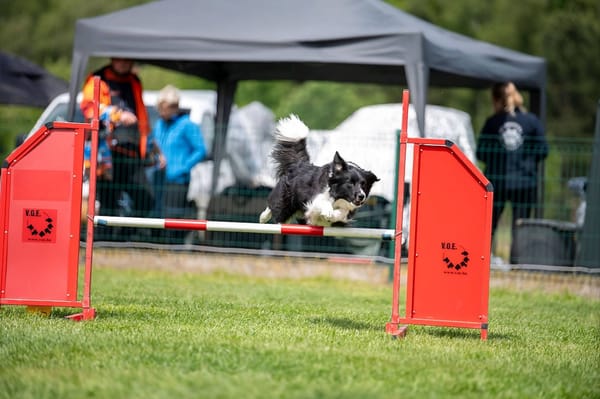
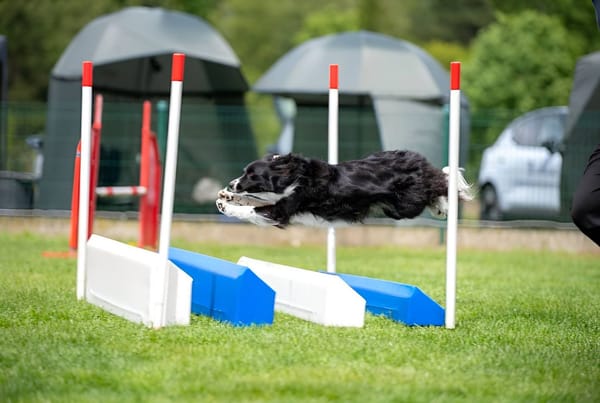
Hurdle (NL: horde, sprong; FR: haie): the basic jump.
I
IFCS: International Federation of Cynological Sports, which organises the IFCS World Agility Championships. VOE is its Belgian member.
Intermediate: the height category for dogs of 43 to under 48 cm at the withers.
J
Jumping class: a run without contact obstacles.
K
Ketschker: a tight wrap around a jump wing combined with a change of side behind the jump.
KKUSH: Koninklijke Kynologische Unie Sint-Hubertus (FR: URCSH, Union Royale Cynologique Saint-Hubert), Belgium's FCI member. Its agility competitions are run by Section 4C. See Agility in Belgium.
Knockdown: a fault caused by knocking down a bar or part of an obstacle.
L
Lead-out: leaving the dog in a stay at the start and walking ahead before releasing it.
Long jump (NL: verspringen; FR: saut en longueur): a jump made of 2 to 4 low units in a row.
M
MCT (Maximum Course Time): the time after which the dog is eliminated.
Measuring: official measurement of the dog's height at the withers to determine its category.
O
Off-course: taking the wrong obstacle; leads to elimination.
R
Rear cross: a change of side in which the handler crosses behind the dog.
Record book / licence (NL: prestatieboekje, licentie; FR: carnet de travail, licence): the dog's competition record.
Refusal (NL: weigering; FR: refus): stopping in front of an obstacle, running past it, or other incorrect attempts; 5 faults.
Running contact: a contact behaviour in which the dog runs through the contact zone without stopping.
S
SCT (Standard Course Time): the time within which the course must be completed to avoid time faults.
Seesaw (NL: wip; FR: balançoire): the tipping contact obstacle.
Serpentine: a sequence of jumps in a line that the dog takes back and forth while the handler stays on one side.
Spread hurdle (NL: dubbele sprong; FR: oxer): two hurdles placed together, ascending.
Start line stay: the dog waiting at the start until released.
T
Threadle: a handling move in which the dog is drawn between two obstacles and then takes the second towards the handler.
Time faults: penalty for going over the SCT, one per second.
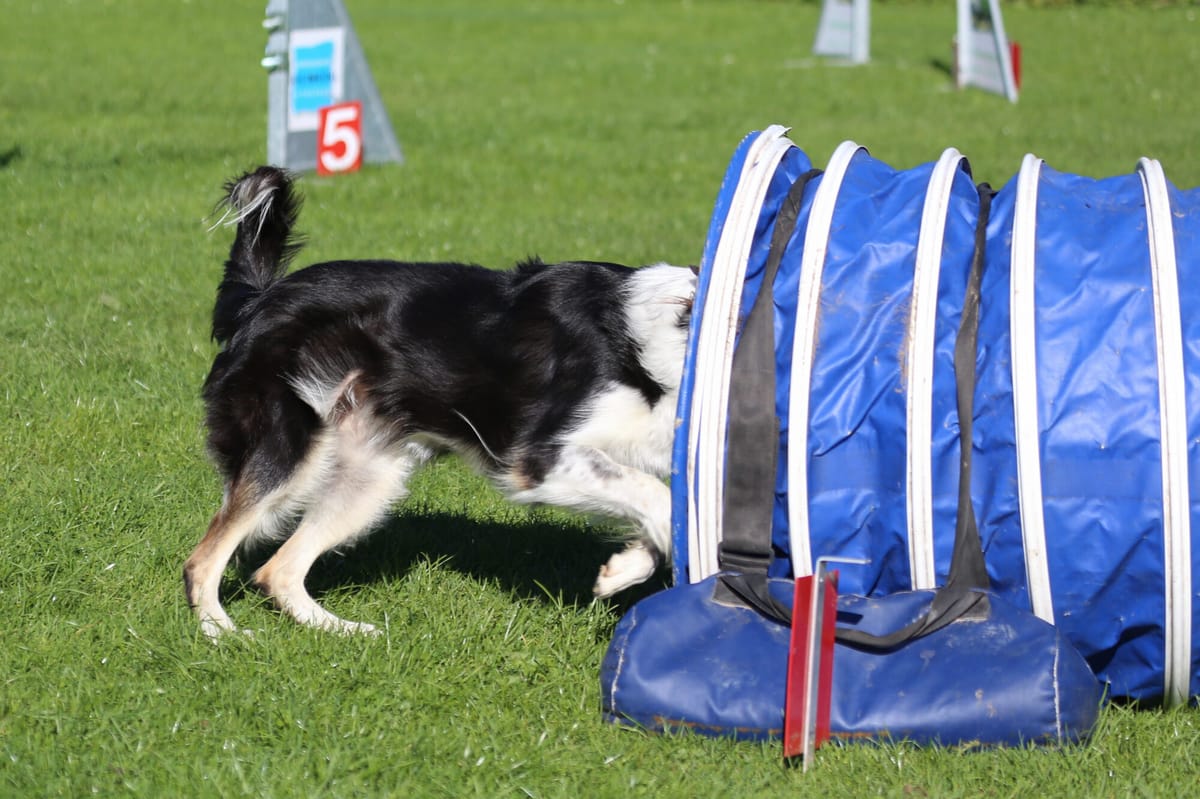
Tunnel (NL: tunnel, buis; FR: tunnel): a flexible tube, 60 cm in diameter.
Tunnel suck: a dog's tendency to take a tunnel instead of the intended obstacle.
Two-on, two-off (2o2o): a stopped contact with the back feet on the ramp and front feet on the ground.
Tyre (NL: band; FR: pneu): a ring the dog jumps through.
V
VOE: Hondenfederatie V.O.E., a Belgian dog sports federation based in Ingelmunster with many affiliated agility clubs, and Belgium's member of the international federation IFCS. See Agility in Belgium.
W
Wall (NL: muur; FR: mur): a solid-looking jump with removable top units.
Weave poles (NL: slalom; FR: slalom): a line of 12 poles that the dog weaves through. See Teaching Weave Poles.
Wing: the side panels of a jump.
Withers: the highest point of the shoulder blades, where dogs are measured.
Wrap: a tight turn around a jump wing.