Agility Handling: Front Cross, Rear Cross, Blind Cross and More
Front cross, rear cross, blind cross, ketschker, German turn, serpentine, threadle: a clear guide to the most important agility handling moves and when to use each one.
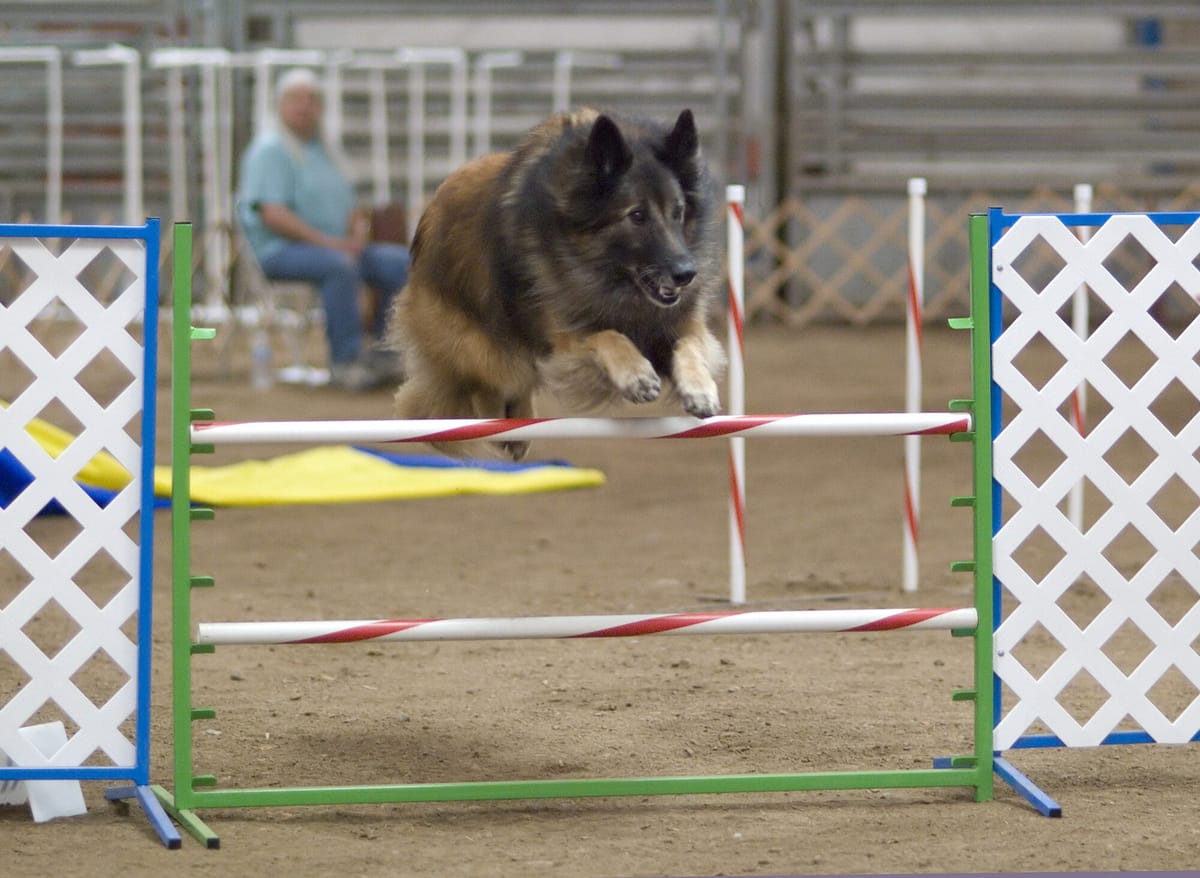
Agility dogs read their handlers' bodies far more than their words. Where your shoulders point, how fast you move and where you look all tell your dog which obstacle comes next. Handling is the art of using that body language to guide your dog around the course efficiently.
This guide explains the most common handling moves. Different handling systems and trainers use slightly different terms and techniques, so your trainer may describe things differently, but the principles are the same.
The basics: how dogs read you
Before learning crosses, understand the signals your dog uses:
- Shoulders and feet: the dog follows the direction your upper body and feet point. Turn your shoulders and the dog turns.
- Motion: when you accelerate, your dog extends. When you decelerate, it collects (shortens its stride) to prepare for a turn.
- Arm: your arm on the dog's side points the line. It supports your body, it doesn't replace it.
- Connection: looking at your dog keeps it with you. Looking at the next obstacle can send it there.
- Verbals: your words add information: obstacle names, directional cues ("left", "right"), or turn cues ("check", "wrap").
The dog's side is the side of your body the dog is on. Changing sides is what the crosses below are all about.
Front cross
What: You change sides by crossing in front of the dog, turning towards it.
How: Get ahead of your dog, then rotate towards it, smoothly switching your arm, so it ends up on your other side. You keep your eyes on the dog throughout.
When: Turns where you can get ahead, especially tight turns after a jump or at the exit of a tunnel. Front crosses give your dog early information and tight turns.
Common mistakes: crossing too late (the dog is already committed), or standing in the dog's path so it has to go wide.
Rear cross
What: You change sides by crossing behind the dog, while it drives ahead.
How: Send the dog forward to an obstacle, then cross the line it's running behind it. The dog turns away from you, towards the new side.
When: When the dog is ahead and you can't get in front for a front cross, especially with fast dogs. Great for keeping the dog moving forward.
Common mistakes: crossing too early (the dog turns back to you) or not supporting the obstacle long enough so it runs past.
Blind cross
What: You turn away from the dog, briefly losing eye contact, and pick it up on the other side.
How: While the dog is behind you, you switch sides by turning your back to it quickly, then reconnect.
When: On straight lines where you need to get ahead fast and change side without slowing down. It's very efficient but needs timing; some judges' courses almost demand it.
Common mistakes: doing it when the dog is already beside you, so it crosses into your path, or leaving your dog without information for too long.
Ketschker (Ketschker turn)
What: A tight wrap around a jump wing where you change side behind the jump, with a blind-style rotation, to send the dog round the wing and away.
How: As the dog approaches the jump, you turn your back on it towards the wing and pick it up on your other side after it lands. The dog wraps the wing tightly.
When: Tight 180° and 270° turns where you need to leave quickly towards the next line. Popular in European handling, including Belgium.
German turn
What: A wrap in which the dog turns tightly around the wing while you stay on the same side, rotating with the dog and facing it, before sending it on. Terminology varies between countries and trainers, so ask your trainer how they define it.
When: Tight turns where the next obstacle lies back on the take-off side.
Serpentine
What: The dog jumps a line of hurdles back and forth (like a slalom) while you stay on one side.
How: You use your shoulders to call the dog in over the jump towards you, then push it out again, staying roughly on a line parallel to the jumps.
When: On courses where three jumps are set side by side. Good serpentines save handlers a lot of running.
Threadle
What: You pull the dog between two obstacles, then send it over the second one from the far side, towards you.
How: Use the arm away from the dog and turn your shoulders back towards it to draw it through the gap.
When: A classic test in jumping courses. Judges love threadles because they require the dog to understand the handler's line, not simply go to the obvious obstacle.
Backside (push) jumps
What: The dog jumps a hurdle from the "back" side, the side facing away from you.
When: Increasingly common at higher levels. They require you to send the dog around the wing and push it over the bar. Taught with a strong understanding of wing wraps and verbals.
Lead-out
Not a cross, but crucial. On the start line, you leave your dog in a stay and walk out ahead to a position from which you can direct the first few obstacles. A reliable start-line stay saves you a big chunk of running. Release with your chosen word and move.
Distance handling
Distance skills let you send the dog ahead to obstacles while you take a shorter line. They're especially useful for handlers who can't run as fast as their dog. Build them with send-outs to tunnels and jumps, directional cues and strong obstacle commitment.
How to choose a technique
When walking the course, ask yourself:
- Where must the dog turn, and how tight? Tight turns favour front crosses, ketschkers or wraps.
- Where can I be? If you can get ahead, a front cross; if not, a rear cross.
- Where are the traps? An off-course tunnel or a wrong-end entry may force you to be in a specific place.
- What suits my dog? A fast, forward-driving dog may love rear crosses; a dog that hates you turning your back may struggle with blinds.
- What suits me? Choose the plan you can execute confidently. A simple plan run well beats a clever plan run late.
Training tips
- Learn moves without your dog first. Walk them with a friend acting as "dog", or with a toy on a stick.
- Teach on a single jump or wing. Most handling moves can be practised with one or two wings.
- Train both sides equally. Every handler has a weaker side.
- Film and review. Late crosses show up immediately on video.
- Take seminars. Belgian clubs regularly host handling seminars with national and international trainers, a great way to sharpen your skills. Check your club, VOE or DSAB communication channels for announcements.
- Draw the exercise. In our course designer you can mark a wrap or back side on each jump and see the dog’s path straight away.