Contacts: Running vs Stopped
Two-on two-off or a running contact? The pros and cons of each method for the A-frame, dogwalk and seesaw, and how to choose the right one for your dog.
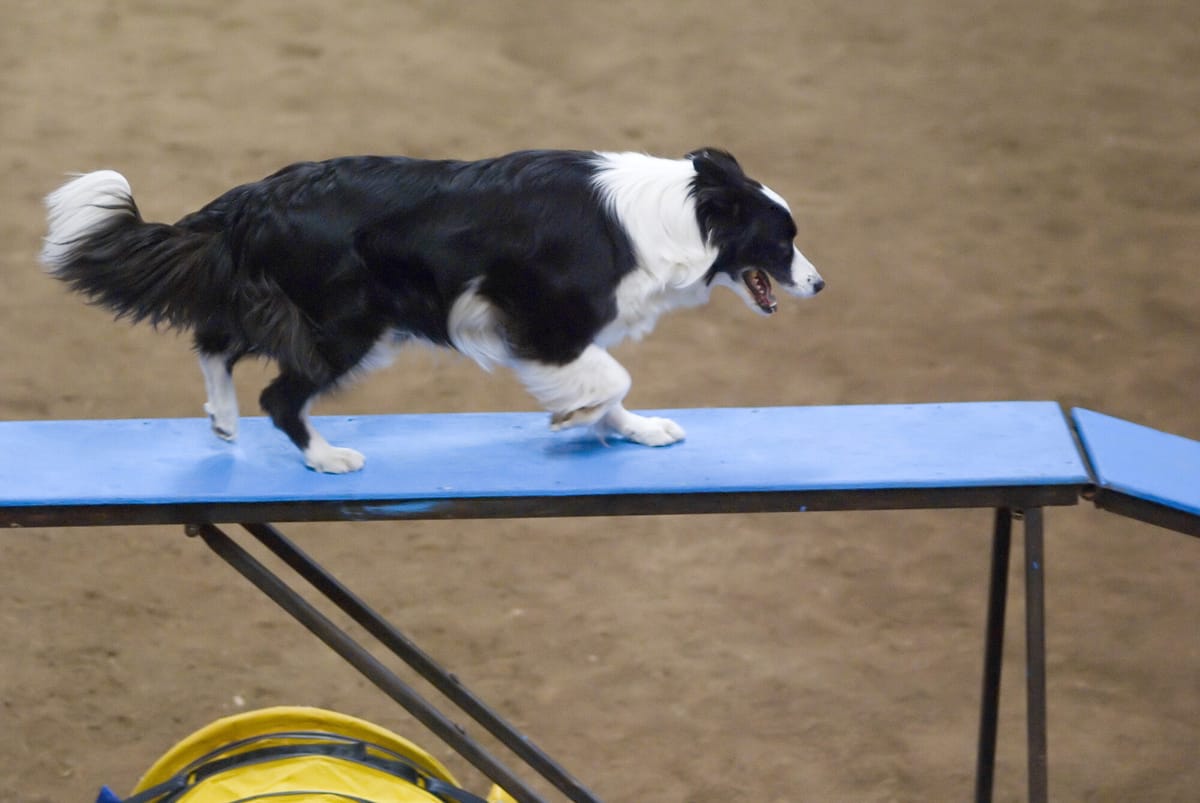
Few topics divide agility trainers as much as contacts. Should your dog stop at the bottom of the dogwalk and wait for your release, or run straight through the yellow zone at full speed? Both approaches win championships. The right answer depends on your dog, your handling and how much time you can put into training.
What the rules require
Under FCI rules, the A-frame, dogwalk and seesaw have coloured contact zones at the bottom of each ramp: 106 cm on the A-frame and 90 cm on the dogwalk and seesaw. The dog must touch the down contact with at least one paw or part of a paw; on the seesaw it must touch both the up and down zones. Missing a contact costs 5 faults. (See FCI Agility Rules Explained.)
Judges look at the contact zone as the dog leaves. A dog that leaps from the middle of the ramp to the ground will miss it. Because contact errors are so common, and so costly in a sport where hundredths of a second count, most handlers train a specific contact behaviour.
Stopped contacts
The dog runs down the ramp and stops in a fixed position until released.
Two-on, two-off (2o2o)
The most popular stopped contact: back feet on the end of the ramp, front feet on the ground, nose often pointing forward or targeting the ground.
Pros:
- Very clear criteria for the dog: it's either in position or not.
- Easier to train and maintain for most handlers.
- Gives the handler time to move to the next position (useful for slower handlers).
- Reliable under competition pressure.
Cons:
- Slower: the stop and release typically cost a second or more per contact.
- Stopping on a steep descent puts load on the shoulders and front legs.
- Some dogs creep or release themselves in competition, where you can't reward or correct the behaviour.
Four-on-the-floor and lie/sit on the ramp
Some handlers ask the dog to run off the ramp and stop with all four feet on the ground, or to lie down in the contact zone (common on the A-frame and for small dogs). The principle is the same.
Training a 2o2o, in brief
- Teach the position on a low plank or step at home: back feet up, front feet down.
- Add a nose target if you like.
- Back-chain: start the dog close to the bottom of the plank, then gradually higher up.
- Transfer to a lowered dogwalk or A-frame, then gradually raise it.
- Add distractions: you running past, you stopping, toys thrown ahead.
- Always release with a clear word. Never let the dog decide.
Running contacts
The dog runs through the contact zone at full speed without stopping, hitting the zone with its stride.
Pros:
- Faster, sometimes by several seconds over a whole course.
- No sharp braking on the descent, which some consider better for the dog's body.
- Handlers don't need to wait; the dog drives on.
Cons:
- Harder and longer to train. A running dogwalk can take a year or more.
- Criteria are less clear for the dog (it's about stride, not position).
- Can break down under competition excitement, and it's difficult to maintain without training aids.
- Not every dog's stride suits it, especially on the dogwalk.
How running contacts are trained
Most methods teach the dog to keep a specific stride and hit the bottom of the ramp, usually starting on a flat plank on the ground and building speed before gradually raising the plank. Training aids include hoops at the bottom of the ramp, toys thrown ahead, or video analysis to check foot placement. On the A-frame, where the zone is longer, many dogs adjust their stride naturally, so running A-frames are common even among teams with a stopped dogwalk.
The seesaw: a special case
Because the seesaw moves and must touch the ground before the dog leaves, a full-speed running contact isn't possible in the same way. Most dogs either ride the board to the ground in a 2o2o position, or adopt a "rocket" style: running to the end and riding the board down with the weight low. Whatever you choose, safety comes first: the dog must be confident with the movement and the noise.
Mixed solutions
Many top teams combine methods:
- Running A-frame, stopped dogwalk.
- Running contacts on both, with a stop on the seesaw.
- 2o2o in the early competition years, moving to running contacts later (or vice versa).
How to choose
| Question | Leans towards stopped | Leans towards running |
|---|---|---|
| How much training time do you have? | Limited | Lots |
| How fast is your dog compared to you? | Much faster | You can keep up, or you rely on distance skills |
| How does your dog cope with excitement? | Gets over-aroused | Stays thoughtful |
| Ambition? | Consistent clear rounds | Every hundredth counts |
| Body | Robust, compact | Careful about load on shoulders |
There's no wrong answer. Talk to your trainer, look at your dog, and pick one method to train properly. Switching back and forth is the surest way to confuse your dog.
Maintaining contacts in competition
- Be consistent. If you accept a broken position in competition, your dog learns that the rules are different there.
- Train in many places. Different equipment, surfaces and environments.
- Proof against your movement. The hardest test is the handler running past the contact at full speed.
- Use fun or practice runs where they're offered. Some events, in Belgium and abroad, have runs outside the official classes where you can reward or fix behaviour in the ring. Ask your club or check the event announcements of the organisation you compete with, such as VOE or DSAB.